CHOOSE YOUR CLINIC
Treating progressive hair thinning in Montreal and Laval requires adjusting therapeutic minoxidil pathways to match gender-specific hair follicle biochemistry. While both sexes utilize the same active compound to widen blood vessels and extend the hair’s active anagen growth phase, success relies on balancing topical concentrations (such as 5% once-daily foam for women versus 5% twice-daily for men) or utilizing advanced Low-Dose Oral Minoxidil (LDOM) therapies. Early dermatological intervention at Clini-Derma reduces genetic follicular miniaturization rates.
Navigating the emotional stress of sudden or progressive hair loss can be incredibly challenging. For residents across Montreal and Laval, finding a definitive, medically backed solution often leads to a common, time-tested compound: Minoxidil. While this active ingredient is readily available over-the-counter across Quebec pharmacies, treating hair thinning effectively involves much more than simply picking up a generic bottle from a local shelf.
Men and women experience distinct biological hair loss patterns driven by completely different hormonal and systemic factors. Because hair follicles react uniquely based on your internal biochemistry, applying the incorrect strength or formulation can trigger severe scalp irritation or unwanted cosmetic side effects. Achieving true, visible density recovery requires understanding the underlying science of your scalp and tailoring your protocol under expert dermatological guidance.
Minoxidil is a Health Canada and US FDA-approved medication for hair loss treatment in men and women. It works by widening blood vessels in the scalp, increasing blood flow, and extending the active growth phase of the hair cycle. The recommended concentrations, formulations, application frequencies, side effect profiles, and the hair loss issues differ for both sexes. Therefore, the patients across Montréal, Laval, Gatineau, Ottawa, and the surrounding areas need clinical guidance from top dermatologists.
Clini-Derma’s medical team aligns all treatments directly with Health Canada and US FDA approval frameworks to ensure patient safety.
Male pattern hair loss (Androgenetic Alopecia in men) is primarily driven by the effect of DHT on genetically susceptible follicles.
Female pattern hair loss (FPHL/Androgenetic Alopecia in women) presents as diffuse thinning over the central scalp with preservation of the frontal hairline. It is more psychologically distressing per episode than in men due to social and identity factors.
As per a 2025 study by the College of Family Physicians in Canada, minoxidil (topical) “improves hair density by about 21 hairs/cm2 versus 5 to 9 hairs/cm2 (placebo) after 16 to 48 weeks.” Both topical and oral minoxidil were found to be similarly effective, albeit with different side effects. However, the study also notes that Finasteride is more effective for men than Minoxidil.
Critical clinical distinction: Women have a wider range of possible causes, such as iron deficiency, thyroid, telogen effluvium, PCOS, and alopecia areata. Minoxidil only treats androgenetic alopecia.
Other hair loss types in women where minoxidil may not be appropriate are-
Women should be evaluated by a dermatologist before starting minoxidil to confirm the cause of their hair loss.
When you visit a Clini-Derma clinic in Montreal or Laval for hair thinning, our board-certified dermatologists don't rely on simple visual guesswork. Instead, we use high-magnification trichoscopy to look beneath the surface of the scalp. This advanced imaging allows us to measure the exact ratio of thick terminal hairs to shrinking, miniaturized hair shafts.
Follicular miniaturization is the hallmark of androgenetic alopecia; over time, hormones like dihydrotestosterone (DHT) choke the follicle, causing each new hair cycle to emerge thinner and weaker until the follicle stops producing hair entirely.
This is where understanding the true biochemistry of Minoxidil becomes essential. Minoxidil is a prodrug, meaning it is completely inactive when it first touches your skin. It relies on a specific enzyme found in your hair follicle roots—called sulfotransferase (SULT1A1)—to convert it into its active form: minoxidil sulfate.
Clinical studies show that many hair loss patients are "non-responders" to topical minoxidil simply because their scalps naturally lack high levels of this SULT1A1 enzyme. To solve this problem, our dermatologists often prescribe Low-Dose Oral Minoxidil (LDOM). By taking the medication orally, it passes through the liver, which is packed with abundant sulfotransferase reserves. The liver easily converts the medication and delivers the active minoxidil sulfate straight to your hair follicles through the bloodstream, triggering robust hair growth even if topical solutions have failed you in the past.
In Clini-Derma’s Montreal and Laval clinics, our specialists utilize advanced trichoscopy to differentiate androgenetic alopecia from underlying systemic triggers like PCOS or iron deficiency.
Approved concentration for men:
Approved concentration of minoxidil for women:
| Feature | Liquid Solution | Foam |
| Propylene glycol | No (5%) / Yes (2%) | No |
| Drying time | 2–4 hours | 20–30 minutes |
| Concentration available | 2% and 5% | 5% only |
| Facial drip risk | Higher | Lower |
| Scalp irritation risk | Higher | Lower |
| Best for | Men, or women with thick hair partings | Women, sensitive scalps |
| Application frequency | Twice daily | Once daily (5% women) |
Table 1: Foam vs. Liquid Solution Formulation Comparison
Women can safely use men's minoxidil under a dermatologist's guidance. Chemically, 2% minoxidil for men and women is of identical aspects.
Many dermatologists now recommend 5% foam for women, typically marketed as 'for men'. It adheres to the scalp better and reduces the risk of facial hair growth in women.
Caution: Consistency is more important than frequency. Using twice daily with frequent missed doses performs worse than using once daily with perfect adherence.
Think of your hair follicles like a battery that needs a continuous, steady charge to stay on. Minoxidil works by continuously keeping the blood vessels wide open around those roots. If you apply it twice a day but constantly miss your weekend doses, the "charge" drops completely, forcing the follicles back into their resting state. Applying a 5% foam perfectly once every single day creates a steady, reliable rhythm that yields vastly superior results compared to applying a liquid twice a day with frequent interruptions.
For men, the target application area is the crown (vertex) and the top of the scalp
For women, the application area is wider to diffuse thinning across the central scalp.
In case of oral minoxidil, men typically use 1.25 to 5mg oral doses, and women use lower 0.25 to 1mg oral doses. These doses were maintained to balance efficacy against risks like unwanted facial hair growth.
Do not stop treatment, as it is not a sign that minoxidil is failing. It resolves within the first 2-3 months.
Other types of risks include-
| Side Effect | Minoxidil side effects in men (Risk Level) | Minoxidil side effects in women (Risk Level) | Notes |
| Initial shedding phase | Moderate (~15%) | Moderate (12–17.5%) | Temporary; expected |
| Scalp irritation/itching | Common | Common | More common with a liquid solution |
| Hypertrichosis (facial/body hair) | Low | Moderate–High | Greater cosmetic concern for women; foam reduces risk |
| Contact dermatitis (propylene glycol) | Uncommon | Uncommon | Foam is propylene glycol-free |
| Scalp dryness/flaking | Common | Common | Usually, temporary |
| Dizziness/low blood pressure | Rare (topical) | Rare (topical) | More relevant for oral minoxidil |
| Pretibial oedema (ankle swelling) | Rare (topical) | Rare (topical) | More relevant for oral minoxidil |
| Cardiovascular effects | Very rare (topical) | Very rare (topical) | Relevant for oral; requires physician monitoring |
Table 2: Minoxidil Side Effects On Women and Men
While mild scalp flaking and a temporary initial shedding phase are completely normal reactions, topical minoxidil can occasionally absorb systemically. Stop using the medication immediately and contact us if you experience any of the following symptoms:
General application rules apply to both sexes in the same way-
Ensure your hair and scalp are 100% dry after showering. Applying minoxidil to a damp head causes the drug to absorb far too rapidly into your bloodstream, which significantly increases your risk of experiencing a racing heartbeat or a sudden headache.
Note: Scalp must be bone-dry.
Create clean parts in your hair using a comb or your fingers to expose the thinning skin of your scalp. Remember: minoxidil only works if it directly touches your skin. Any fluid or foam that gets caught on your hair strands is completely wasted product.
Note: Target the skin, not the hair strands.
1 mL of liquid or half a capful of foam.
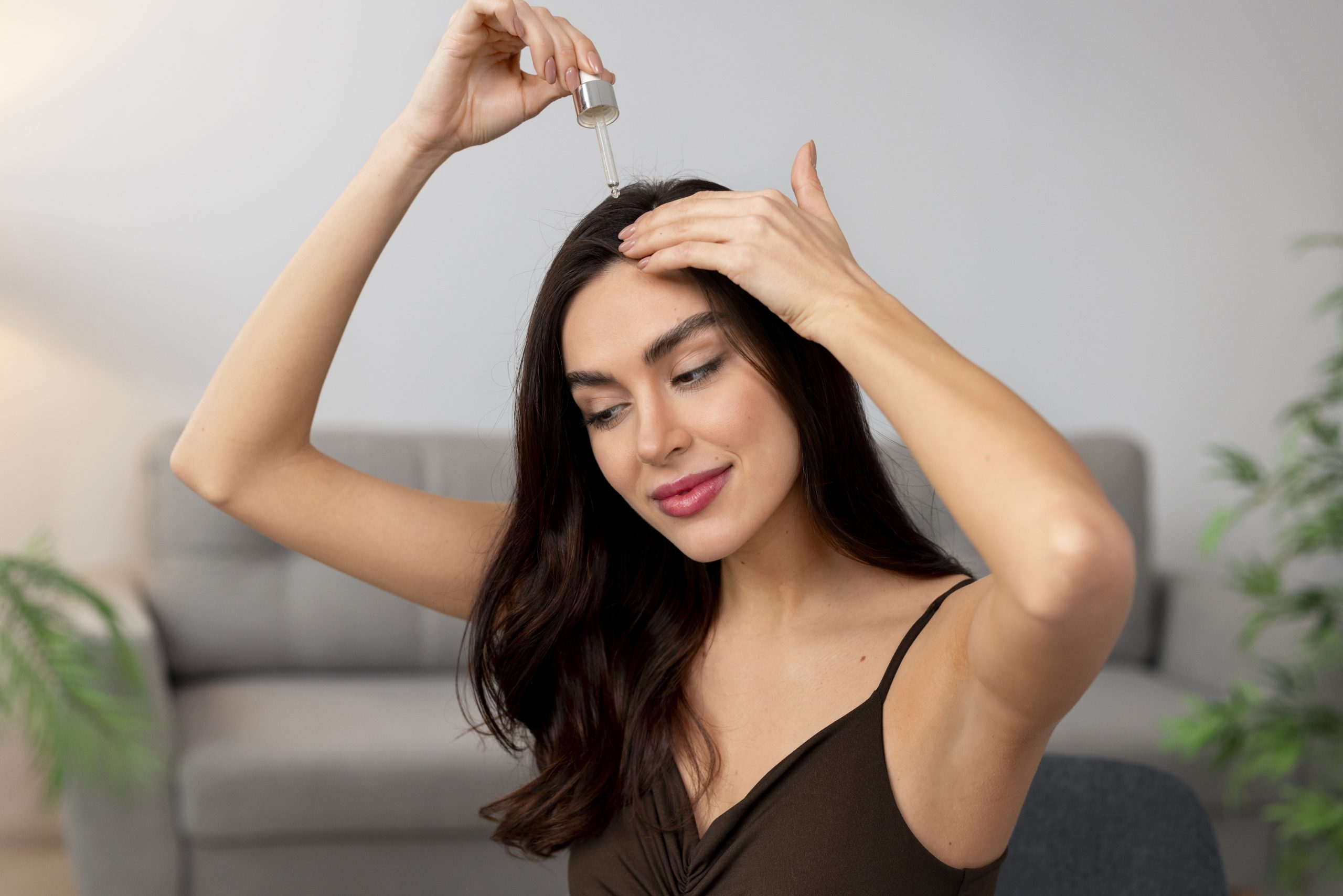
If you are using the liquid solution, drop it directly onto the skin partings. If you are using the aerosol foam, dispense it onto your fingers or straight onto the scalp and use your fingertips to spread it gently across the affected thinning zones.
Wash your hands thoroughly with soap right away to prevent accidentally transferring any leftover medication to your face or eyebrows. Let the medication air-dry completely; do not use a hairdryer, as intense heat can evaporate the active solution before your hair roots can absorb it.
Note: Critical 4-hour absorption window.
Following strict dermatological protocols, Clini-Derma advises keeping the scalp dry for a minimum of four hours post-application to guarantee optimal drug absorption.
While daily minoxidil use forms a vital foundation for hair preservation, top dermatologists rarely use it in isolation for advanced thinning. To achieve the absolute highest level of hair density, Clini-Derma integrates minoxidil into a comprehensive, multi-modal treatment pipeline.
Our specialists harvest a small sample of your own blood, spin it in a high-speed centrifuge to isolate concentrated growth factors, and gently inject it directly into the thinning areas of the scalp. While minoxidil keeps blood vessels open, PRP acts as a powerful cellular fertilizer, shocking resting follicles back into the active anagen growth phase.
For male patients and select post-menopausal female patients, minoxidil is paired with oral 5-alpha reductase inhibitors (such as Finasteride or Dutasteride). Minoxidil stimulates growth from the bottom up, while these targeted medications block DHT from destroying the follicle from the top down.
For patients undergoing Follicular Unit Extraction (FUE) hair transplants at our clinics, minoxidil is a critical tool used to accelerate healing and prevent "shock loss" (the temporary shedding of native hairs surrounding the newly transplanted grafts).
Topical minoxidil for men and women contains the identical active ingredient and works the same way. The key differences lie in the application/ oral intake frequency of minoxidil and the concentration in the case of topical minoxidil.
Contact your nearest Clini-Derma clinic for a professional assessment of your hair loss. Our board-certified dermatologists serve Montréal, Laval, Gatineau, Ottawa, and the surrounding areas. Book a consultation today!
Using a higher concentration (like 5%) meant for men can occasionally trigger hypertrichosis, or stray facial hair, in women.
Visiting a specialized clinic like Clini-Derma ensures you receive the exact, medically appropriate formulation to maximize scalp hair growth while keeping your face completely clear.
Yes, a brief “shedding phase” is a normal sign that old strands are making way for healthier growth, but it can be frightening to experience alone.
Clini-Derma’s dermatologists guide you through this temporary phase with customized support, ensuring your treatment is working exactly as it should.
Men and women have different underlying hormonal causes for hair loss, meaning a generic, one-size-fits-all bottle rarely delivers optimal results.
Clini-Derma provides expert, gender-specific diagnostic assessments to tailor your treatment plan for real, visible density.
Topical solutions often contain propylene glycol, which causes itching and flakes, while generic foams can leave hair looking flat.
At Clini-Derma, specialists can prescribe alternative formulations or complementary therapies that fit seamlessly and comfortably into your daily routine.
While 2% is the traditional standard for women, 5% foam is frequently prescribed off-label with highly effective results when monitored correctly.
Clini-Derma eliminates the guesswork by providing clear, personalized medical oversight so you can use the most effective strength safely.